

Natural Supplements in Pregnancy: Are They Safe?
Quick Summary
Natural supplements in pregnancy are not automatically safe. Safety depends on the specific product, its dose, the stage of pregnancy, and what else you take, so check with your provider before starting any natural supplements pregnancy products.
- Not every natural product is safe, and plant origin says little about how a product behaves in pregnancy.
- The FDA does not review most dietary supplements for safety or effectiveness the way it reviews prescription medications.
- The FDA recommends 400 micrograms of folic acid daily for anyone who is or may become pregnant.
- Herbs such as black cohosh, dong quai, and goldenseal are listed among those to avoid during pregnancy.
- Confirm all interactions with prescriptions and other supplements, and bring a complete list to prenatal appointments.
Table of Contents
- Why Natural Does Not Automatically Mean Safe in Pregnancy
- Prenatal Vitamins and Supplements: The Nutrients Pregnancy Actually Requires
- Herbs to Avoid During Pregnancy and Those Needing Caution
- Supplement Interactions During Pregnancy: Medications and Other Products
-
A Practical Safety Check Before Taking Any Product and What to Do After Accidental Use
- Step 1: Confirm the purpose and the evidence tier
- Step 2: Read the full label, including the supplement facts panel
- Step 3: Check for pregnancy warnings, and treat silence as unknown
- Step 4: Review interactions with everything else you take
- Step 5: Assess product quality, contamination, and label reliability
- Step 6: Ask your provider before the first dose
- Step 7: Start only one new product at a time
- What to do after accidental use
- Talking With Your Provider About Your Supplement Plan
- Frequently Asked Questions
Why Natural Does Not Automatically Mean Safe in Pregnancy
Last Updated: October 29, 2026
Are natural supplements for pregnancy safe? Not automatically. Many pregnant women assume a plant-based product must be gentler than a prescription drug, but that assumption does not hold up.
Herbal use during pregnancy is more common than many people expect. One study of 297 pregnant women found that 56% reported using herbal medicine (PMC study on herbal medicine use among pregnant women).
Popularity does not equal proof, though. A 2026 systematic review on herbal medicine use in pregnancy concluded that potential effects on offspring remain uncertain and need further study (ScienceDirect systematic review on herbal medicine in pregnancy).
The "natural" label itself can be misleading. Many herbal products are viewed as safe because they come from plants.
Regulation adds another concern. The U.S.
So what should you do with natural supplements pregnancy questions?
Prenatal Vitamins and Supplements: The Nutrients Pregnancy Actually Requires
Prenatal nutrition is about meeting known needs, not chasing every trend. Food and Drug Administration recommends 400 micrograms (0.4 mg) of folic acid daily for anyone who is or may become pregnant (FDA dietary advice during pregnancy).
Folic acid supports healthy neural tube development in the earliest weeks, often before a pregnancy is confirmed. That timing is why it matters so much.
Other nutrients often discussed with prenatal care include:
- Folic acid: Supports early neural tube development
- Iron: Supports the increased blood volume of pregnancy
- Iodine: Supports fetal brain development
Prenatal vitamins are regulated more closely than most herbal products, and their doses are designed around pregnancy. You can browse the full product range to see what is offered.
The article lists several nutrients often discussed with prenatal care, and folic acid timing is the key point.
| Nutrient | What it supports | Note |
|---|---|---|
| Folic acid | Early neural tube development | 400 micrograms daily per FDA advice; matters before pregnancy is confirmed |
| Iron | Increased blood volume of pregnancy | Listed as a commonly discussed prenatal nutrient |
| Iodine | Fetal brain development | Listed as a commonly discussed prenatal nutrient |
| Vitamin D | Bone health and immune function | Listed as a commonly discussed prenatal nutrient |
Herbs to Avoid During Pregnancy and Those Needing Caution
Not every herb carries the same level of concern. Some have limited safety data in pregnancy, and others have well-documented risks. Avoid herbs with unclear safety profiles unless a qualified provider has reviewed them. What follows separates herbs with known or suspected pregnancy concerns from those commonly discussed but poorly studied.
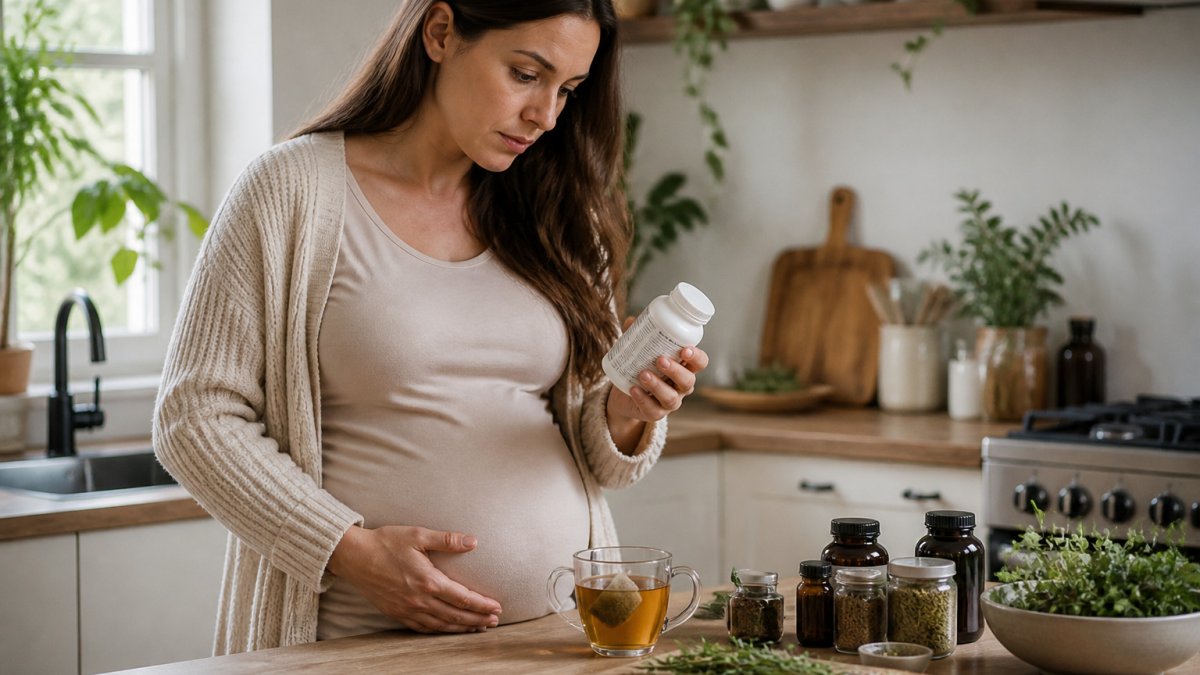
Herbs with known or suspected pregnancy concerns
These are the products most practitioners flag for avoidance or strict provider review during pregnancy:
- Black cohosh: Traditionally used for menopausal symptoms; hormonal activity and case reports of liver injury make it a poor choice in pregnancy.
- Blue cohosh: Associated with uterine stimulation and neonatal complications in case reports; avoid.
- Dong quai: A traditional uterine tonic with estrogen-like activity; avoid.
Herbs commonly discussed as lower risk, with caveats
Some herbs appear in pregnancy surveys and traditional practice more often than others. 'Lower risk' is not 'proven safe,' and the form matters:
- Ginger: Frequently used for nausea. Food amounts and modest tea servings are commonly tolerated; concentrated capsules at high daily doses are a different exposure. Ask your provider about a dose appropriate for you.
- Garlic: A common culinary ingredient and one of the most frequently reported herbs in pregnancy surveys. Food use differs substantially from concentrated capsules.
- Peppermint: Commonly consumed as tea; concentrated peppermint oil is much stronger and should be discussed with a provider.
Why dose and preparation change the risk
The same plant can behave very differently depending on how it is consumed:
- Culinary amounts vs. concentrated extracts: A teaspoon of ginger in food is not the same as a standardized capsule taken daily. Concentration multiplies both the intended compounds and any contaminants.
- Teas vs. tinctures vs. capsules: A cup of tea delivers a far smaller and more variable dose than an alcohol-based tincture or a standardized pill.
- Standardization: Products labeled 'standardized' to a marker compound may deliver a more consistent dose, which also means a more consistent exposure if that compound is a concern.
Evidence grading: separate what is established from what is traditional
It helps to sort claims into tiers rather than treating all 'natural' products as one category:
- Established nutrient recommendations: Folic acid, iron, iodine, and vitamin D have defined pregnancy roles and recommended amounts from public health bodies.
- Limited but suggestive evidence: A few herbs, such as ginger for nausea, have modest trial support at specific doses, but the evidence base is smaller than for standard treatments.
- Traditional use only: Many herbs are used based on long tradition with little or no pregnancy-specific study.
- Known or suspected risk: Herbs with case reports, hormonal activity, or uterine effects belong here, avoid or use only under direct provider supervision.
Read labels closely and ask whether the product is intended for pregnancy use. If a product contains an unfamiliar botanical name, look it up with your provider before using it, and treat a missing pregnancy warning as 'unknown,' not 'safe.'
Supplement Interactions During Pregnancy: Medications and Other Products
Interactions are one of the most overlooked risks. A supplement that seems harmless alone may affect how a prescription works, or combine with another product in unexpected ways.
Pay special attention to:
- Prescription medications, including those for blood pressure or blood sugar
- Over-the-counter pain relievers and cold medicines
- Other supplements, especially multiple products with overlapping ingredients
Keep a complete list of everything you take, including vitamins, teas, and topical products. Bring that list to every prenatal appointment. Providers can only check interactions they know about.
A Practical Safety Check Before Taking Any Product and What to Do After Accidental Use
Before starting any supplement, work through a simple check designed to catch the problems that labels and marketing copy tend to hide.
Step 1: Confirm the purpose and the evidence tier
Know why you want the product and what kind of evidence supports it. Is this an established nutrient need (like folic acid or iron), a limited-evidence use (like ginger for nausea), or a traditional use with little pregnancy data? Applying this same rigorous standard of evidence to your topical routine ensures that your organic skincare rules remain as protective for your developing baby as the supplements you choose to ingest.
Step 2: Read the full label, including the supplement facts panel
Note every ingredient, the dose per serving, the serving size, and whether the product is a blend. A 'proprietary blend' can hide individual doses, making safety review impossible. If you cannot determine how much of each herb you would be taking, pause.
Step 3: Check for pregnancy warnings, and treat silence as unknown
If the label says nothing about pregnancy, do not read that as clearance. Many products simply have not been studied. A missing warning means 'unknown,' not 'safe.'
Step 4: Review interactions with everything else you take
- Prescription medications, including those for blood pressure or blood sugar
- Over-the-counter pain relievers and cold medicines
- Other supplements, especially multiple products with overlapping ingredients
Step 5: Assess product quality, contamination, and label reliability
The U.S. Food and Drug Administration does not review most dietary supplements for safety or effectiveness the way it reviews prescription medications. That means ingredient lists, health claims, and contamination levels are harder to verify. Practical quality checks include:
- Third-party testing seals: Look for marks from independent testing programs that verify identity, potency, and contaminants. A seal is not a pregnancy-safety guarantee, but it reduces the risk of a mislabeled or contaminated product.
- Ingredient accuracy: Independent analyses have repeatedly found that some herbal products do not contain the plant listed on the label, or contain additional plants not disclosed.
- Contaminants: Heavy metals, pesticides, and microbial contamination are documented concerns in some imported or poorly controlled herbal products.
Step 6: Ask your provider before the first dose
Share the product name, the full label, and the dose you are considering. Bring your complete medication and supplement list. Ask specifically whether the product has pregnancy-specific evidence and whether it interacts with anything you already take.
Step 7: Start only one new product at a time
That makes it easier to notice any reaction and to identify the cause if something changes.
What to do after accidental use
If you took something by accident, stay calm and act promptly. Note the product name, the ingredients, the amount, and when you took it. Contact your healthcare provider or a poison control center. In the United States, the national Poison Help line is 1-800-222-1222. For severe symptoms such as heavy bleeding, chest pain, or trouble breathing, call 911 right away.
Talking With Your Provider About Your Supplement Plan
Bring your supplement questions to your prenatal provider before you buy or start anything. You can learn about the naturopathic practitioner behind the business before you book. When you are ready, you can book your appointment online at the practice.
Pregnancy supplement decisions should be made with care, one question at a time. Natural does not mean risk-free, but informed choices can help you feel more confident about what you put into your body.
Frequently Asked Questions
Are herbal supplements safe during pregnancy?
Many herbal supplements have not been well studied in pregnant people, and the U.S. Food and Drug Administration does not review dietary supplements for safety or effectiveness before they are sold. A 2026 systematic review in ScienceDirect notes that herbal medicine use during pregnancy is widespread, but its potential effects on the offspring remain uncertain and need further study. Because natural does not mean risk-free, check with your healthcare provider before starting any herbal product while you are pregnant or trying to conceive.
Which herbs should you avoid during pregnancy?
Herbs to avoid during pregnancy vary by product and dose, so no single list covers every case. Many people with healthcare professional guidance avoid high-dose or concentrated extracts, and any product whose ingredients or safety profile is unclear. Bring the full label to your provider, including dose and preparation, so they can review it against your stage of pregnancy and health history.
Do prenatal vitamins count as natural supplements?
Prenatal vitamins are dietary supplements, but they are formulated around nutrients with established recommended intakes, such as folic acid at 400 micrograms (0.4 mg) daily for people who are or may become pregnant, according to the FDA. Herbal products are a different category with less consistent evidence and quality control.
Can supplements interact with prescription medications during pregnancy?
Yes. Supplements can change how the body absorbs or processes prescription and over-the-counter medicines, and some combinations can increase risk. Share a complete list of everything you take, including vitamins, herbs and teas, with your prescriber and pharmacist before starting or stopping any product. Do not stop a prescribed medication on your own without medical guidance.
